> For the complete documentation index, see [llms.txt](https://docs.cdpi.dev/llms.txt). Markdown versions of documentation pages are available by appending `.md` to page URLs; this page is available as [Markdown](https://docs.cdpi.dev/the-dpi-wiki/dpi-tech-architecture-principles.md).

# DPI Tech Architecture Principles

How do we distinguish regular digitisation efforts from DPI?

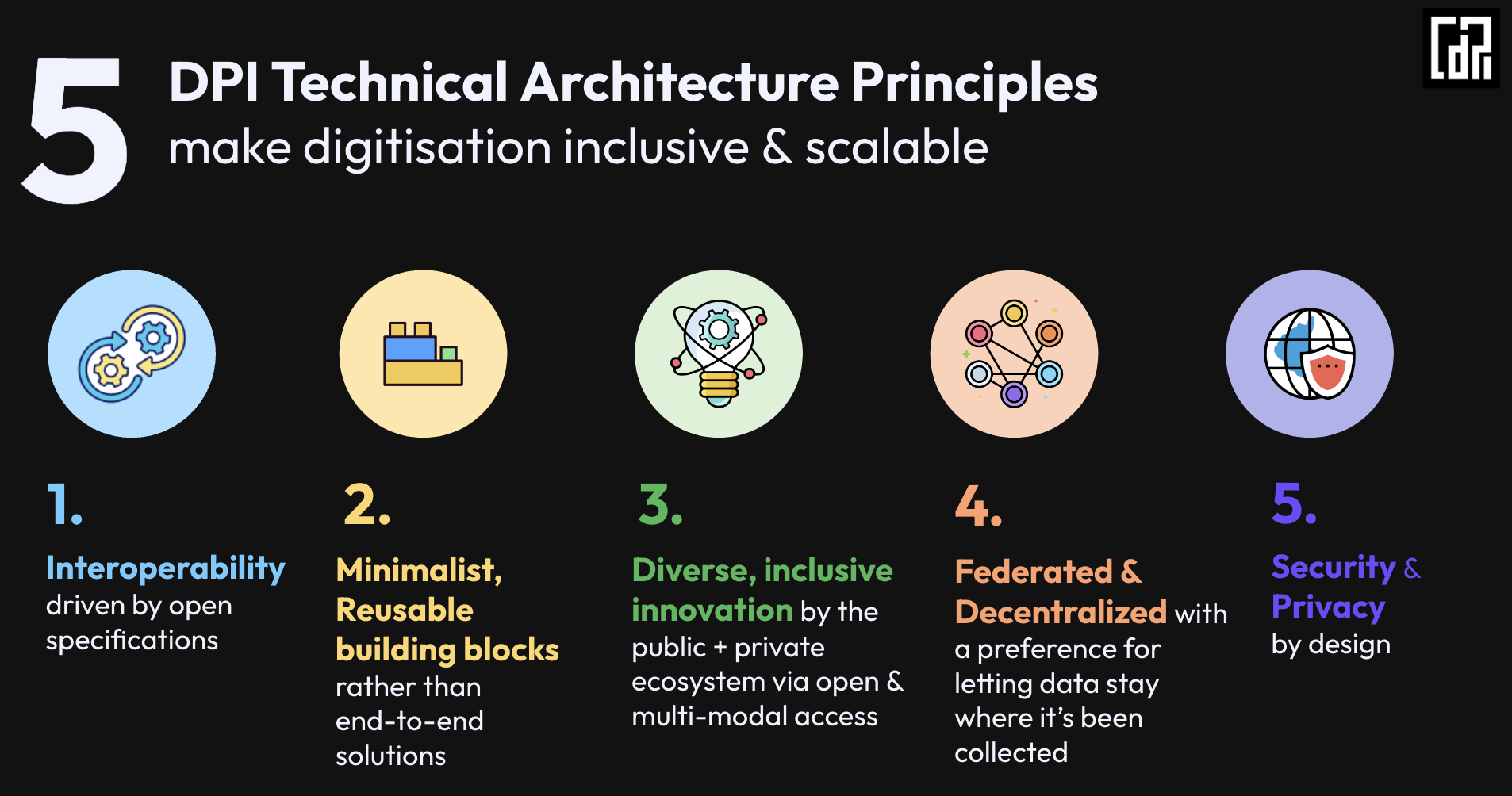
<figure><img src="https://697430317-files.gitbook.io/~/files/v0/b/gitbook-x-prod.appspot.com/o/spaces%2FPSpwXyMDD6nT6RU93idI%2Fuploads%2FtVG4pfO4Xgz9bd2fM7Il%2FScreenshot%202023-06-23%20at%2010.14.08%20PM.png?alt=media&amp;token=59ceeba8-9e64-4375-bd5e-00c770011adb" alt="Five DPI technical architecture principles that make digitisation inclusive and scalable: 1. Interoperability, driven by open specifications. 2. Minimalist, reusable building blocks rather than end-to-end solutions. 3. Diverse, inclusive innovation by the public and private ecosystem via open and multi-modal access. 4. Federated and decentralised, with a preference for letting data stay where it has been collected. 5. Security and privacy by design."><figcaption></figcaption></figure>

The five technology architecture principles above illustrate how DPI efforts can be architected to be distinct from traditional digitisation efforts: 1) [interoperability](/the-dpi-wiki/dpi-tech-architecture-principles/interoperability.md); 2) [minimalist, reusable building blocks](/the-dpi-wiki/dpi-tech-architecture-principles/minimalist-and-reusable-building-blocks.md); 3) [Diverse, inclusive innovation](/the-dpi-wiki/dpi-tech-architecture-principles/diverse-inclusive-innovation.md) by the ecosystem; 4) a preference for remaining [federated and decentralised](/the-dpi-wiki/dpi-tech-architecture-principles/federated-and-decentralised-by-design.md); and 5) [security & privacy](/the-dpi-wiki/dpi-tech-architecture-principles/security-and-privacy-by-design.md) by design.

When implemented, these technical principles help DPIs achieve societal outcomes such as inclusion, user choice, innovation, scale of delivery, speed of services, public trust, competition in markets, and others as outlined below.
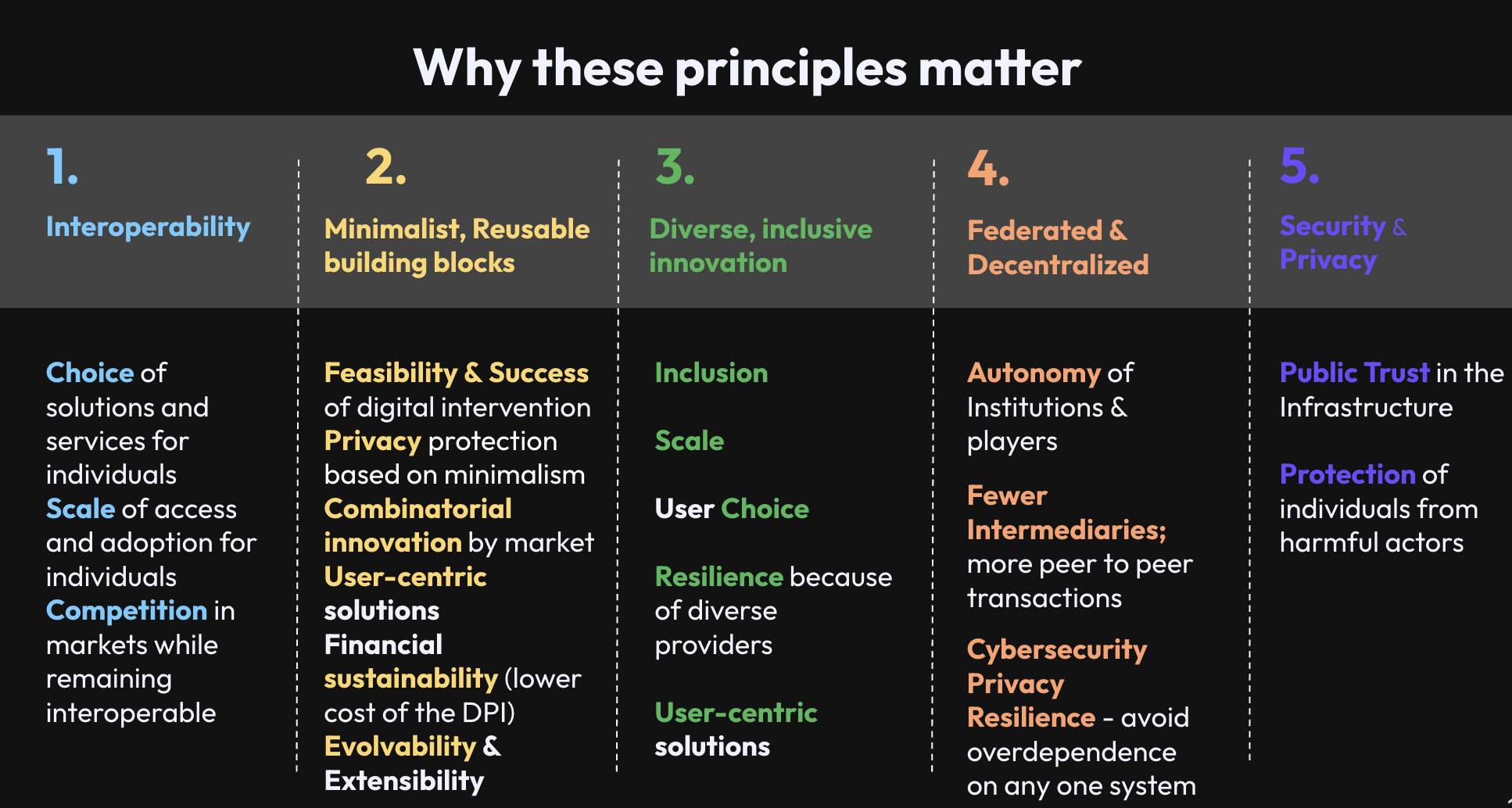
<figure><img src="https://697430317-files.gitbook.io/~/files/v0/b/gitbook-x-prod.appspot.com/o/spaces%2FPSpwXyMDD6nT6RU93idI%2Fuploads%2FGq1Gyn8kYdlCTLWItppV%2FScreenshot%202023-06-23%20at%2010.18.18%20PM.png?alt=media&amp;token=68b33709-ded4-4c01-8837-3d6a639f560d" alt="Why these principles matter. Interoperability: choice of solutions for individuals, scale of access and adoption, competition in markets while remaining interoperable. Minimalist, reusable building blocks: feasibility and success of digital intervention, privacy protection based on minimalism, combinatorial innovation by the market, user-centric solutions, financial sustainability, evolvability and extensibility. Diverse, inclusive innovation: inclusion, scale, user choice, resilience because of diverse providers, user-centric solutions. Federated and decentralised: autonomy of institutions and players, fewer intermediaries, cybersecurity, privacy, resilience by avoiding overdependence on any one system. Security and privacy: public trust in the infrastructure, protection of individuals from harmful actors."><figcaption></figcaption></figure>
